Stability Makes Low Pressure Possible
High-BMI patients present ventilation challenges during bariatric surgery. AirSeal® helps maintain stable visualization at low pressure during retraction, suction, and stapling without relying on higher pressure.
See the difference during suction and smoke evacuation.
Low Pressure Without Compromising Visualization
- In general and bariatric procedures, AirSeal® demonstrated statistically lower peak airway pressure and lower EICO compared to standard insufflation.1
- During Roux-en-Y gastric bypass, AirSeal® reduced operative time by an average of 12.3 minutes and demonstrated lower estimated blood loss compared to conventional access systems.2
- Low-pressure bariatric surgery with AirSeal® showed trends toward lower pain scores, improved mobilization, and shorter hospital stay.3-5
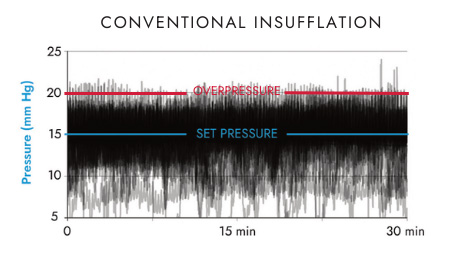
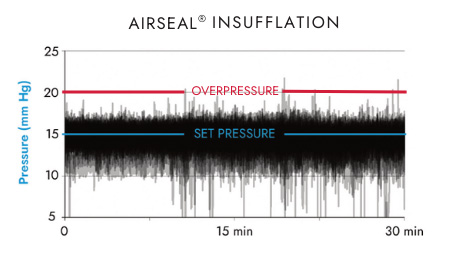
Pressure Stability:
Conventional vs. Advanced Insufflation
Experience Advanced Insufflation in Bariatric Surgery.
See how Advanced Insufflation helps maintain visualization, procedural stability, and lo-pressure surgery in high-BMI patients.
* A CONMED consultant may follow up with additional information
1 Saway JP, McCaul M, Mulekar MS, McMahon DP, Richards WO. Review of Outcomes of Low Versus Standard Pressure Pneumoperitoneum in Laparoscopic Surgery. Am Surg. 2022;88(8):1832-1837. doi:10.1177/00031348221084956.
2 Landman J, et al. Comparison of pneumoperitoneum stability between valveless and conventionl insufflation sysems, Urology. 2016.
3 de'Anaelis N. Brunetti F. Low-pressure AirSeal® in laparoscopic cholecystectomy. Surg Endosc.
4 Ramshaw B. Low-pressure AirSeal® with Exparel in ventral hernia repair. Surg Technol Int.
5 Telem D. Low-pressure AirSeal® in laparoscopic cholecystectomy. SAGES Abstract.