Stability Makes Low Pressure Possible
Conventional insufflation often requires higher pressure to maintain visualization. The AirSeal® insufflation system helps maintain stable pneumoperitoneum enabling low pressure surgery without compromising exposure.
Improve Outcomes in General Surgery
- Patients undergoing laparoscopic cholecystectomy using the AirSeal® insufflation system had a 34.7% shorter length of stay compared to standard insufflation.1
- Clinical studies demonstrated improved ventilatory parameters including lower peak inspiratory pressure and reduced etCO2 during minimally invasive surgery.2
Pressure Stability:
Conventional vs. Advanced Insufflation
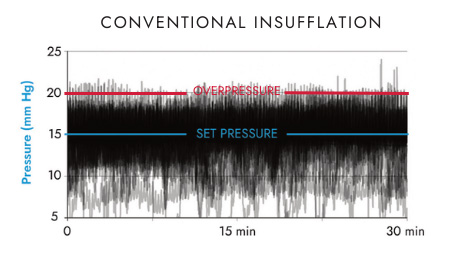
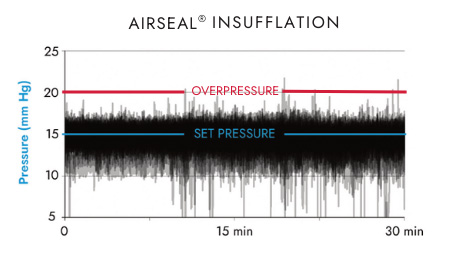
Conventional insufflation can fluctuate significantly during suction and leaks. The AirSeal® insufflation system helps maintain a more stable pneumoperitoneum to support visualization and procedural continuity.
*Preliminary intra-abdominal pressure data from a prospective randomized trial of AirSeal® vs. conventional insufflation3
Experience Stability. Enable Low Pressure.
Make minimally invasive surgery smoother and lower pressure without disruption.
* A CONMED consultant may follow up with additional information
1 Ramshaw Bl.et al. Low-pressure laparoscopic ventral hernia repair usina AirSeal® insufflation was associated with shorten hospital stay and reduced procedure duration. Surg Technol Int. 2016;29:125-130.
2 Telem DA, et al. AirSeal® insufflation during laparoscopic cholecystectomy was associated with reduced hospital length of stay compared to standard insufflation. Presented at: Society of American Gastrointestinal and Endoscopic Surgeons (SAGES); 2017).
3 Bucur P, Hofmann M, Menhadji A, et al. Comparison of pneumoperitoneum stability between a valveless trocar system and conventional insufflation: a prospective randomized trial. Urology. 2016;94:274-280.